Get in touch
Redesigning Brain.FM
Improving Brain.fm’s ADHD mode to better support deep focus and help users enter a flow state during each session. Brain.fm is a music app that helps people reach specific mental states, especially deep focus and productivity.
Team
4 Members
Year
2026
Role
UX Design,. Scrum Master

Context
Tapping into the flow state on demand, for better productivity
For this project, we explored how people use productivity apps, reviewed common focus habits, and spoke with psychologists to better understand what supports sustained attention. Based on those insights, we identified opportunities to improve the ADHD listening mode to effectively help users enter a flow state during each productivity session.
82.8%
of surveyed participants used music to boost concentration while performing tasks.
29%
of improved performance was exhibited in children with ADHD while listening to music.
2.65x
improved retention in neurodivergent care when exposed to music therapy.
Challenge
Designing with empathy
When working with neurodivergent audiences its important to be able to empathize and evaluate with the audience without any bias and with enough evidence.
What is brain.fm
Brain.fm is a science-backed music app that applies neuroscience-based sound design to help people reach specific mental states of focus, relax, sleep, and enter a more productive state of mind. It uses specially engineered audio to support deep focus and flow, rather than just playing background music.

The Problem
Brain.fm uses an honorary system for focus
The current app helps reduce distractions and supports focus, but it doesn’t adjust to the user or respond to what’s happening during the session. This creates an opportunity to make the experience smarter and more robust.
However, it lacks motivation activation itself
Based on the book “100 things about people” and a Hungarian-American psychologist Dr. Mihaly Csikszentmihalyi’s work on flow state, Brain.FM fails to activate a state of focused attention. So our goal was to find a way to make focus activation a part of Brain.FM’s scientific arsenal.
Designed to reduce distraction through immersive audio; but cross-app use and in-app feature density introduce competing attention pulls.
Modes signal intent but remain detached from the user’s real task environment
Flow relies on visible progress and reinforcement

The Process
How well does this app fair
To understand what is cheerful and friendly studied 100s To understand what was needed, we conducted heuristic analysis and did walkthrough exercises of the app to find out problems and possible opportunity areas. There were a few differences on the ratings but some aspects of the app were brought into light which seemed more severe on closer inspection. We scored on the heuristics from 0 to 4, 0 being no usability problem at all to 4 being a usability failure. graphics, apps, compositions and even dipped our feet in color psychology to see what fit the cutout perfectly.
Error Prevention = Rating 4
The groups in explore page start music on click. User may not like this as it changes the current track without warning. and the previous track algo may have been lost.
Match between system and the real world = Rating 3
When clicking on the current title being played, the info shown is of no use to the user. Things like complexity is of no meaning in music.
Aesthetic and minimalist design =Rating 4
Track cards are congested, with like, dislike and download & track info page has little to no usefulness

Doing it ourselves would create biases so we asked others
We conducted 9 user tests with people with ADHD to uncover what we missed, which showed us that there is a lot of meaningless data, not relevant to their focus.
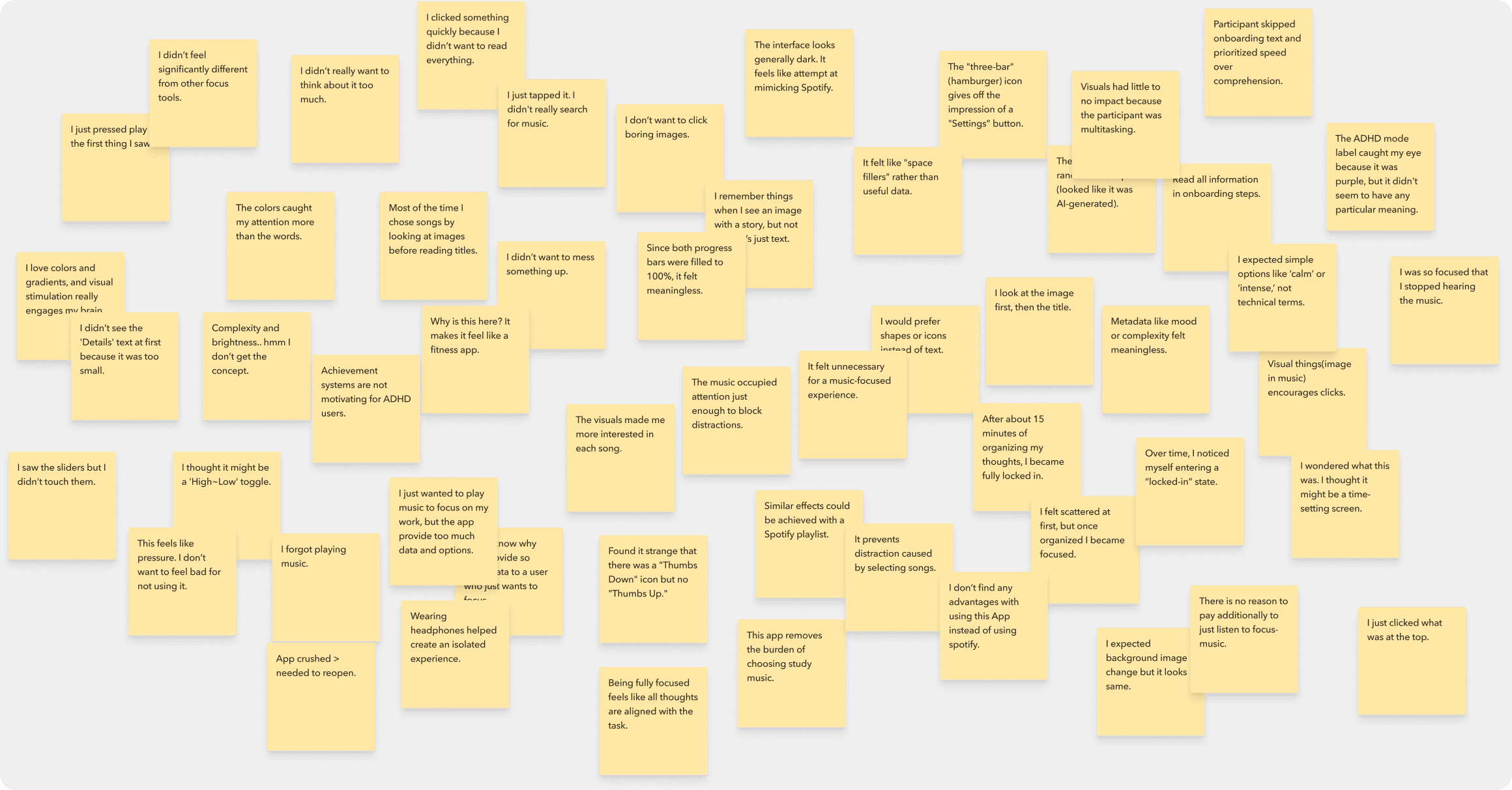
Confusion about technical terms and UI elements
Focus for ADHD users emerges after an initial transition period
Effective focus-support music should become cognitively invisible once a user enters flow.
Unclear instructions decreases proper usage
Visual design and hierarchy drive navigation over text
The ah-ha!
Through literature review and testing, we clearly saw that individuals with ADHD may demonstrate a higher capacity for intense, sustained concentration, often referred to as hyper focus, when tasks are intrinsically motivating. But, the current app does not support an environment to reach this state of undisrupted focus.
Find a way to induce a flow state while the user becomes mentally prepared to work
Reinforce Clear Goals and Intent at the Start of Each Session and find a way to intrinsically motivate users
Enabled and Sustained state of “Flow”

Core of enabling flow
The new experience
The core idea was to help users get into a state of “Flow” where people are so involved in an activity that nothing else seems to matter.
Need for a paradigm shift
Based on an expansive research and data analysis we concluded with 10 design guides for our approach
Give people control over their actions during an activity
->
Break the goal into clear steps so it feels challenging yet achievable.
->
Give constant feedback
->
Minimize distractions

The Design
Improving the status quo
After heuristics, we tested the current design in the real world. Our target was to find focused areas for improvements. One such focus area that showed need for improvement was UX writing and Information architecture.
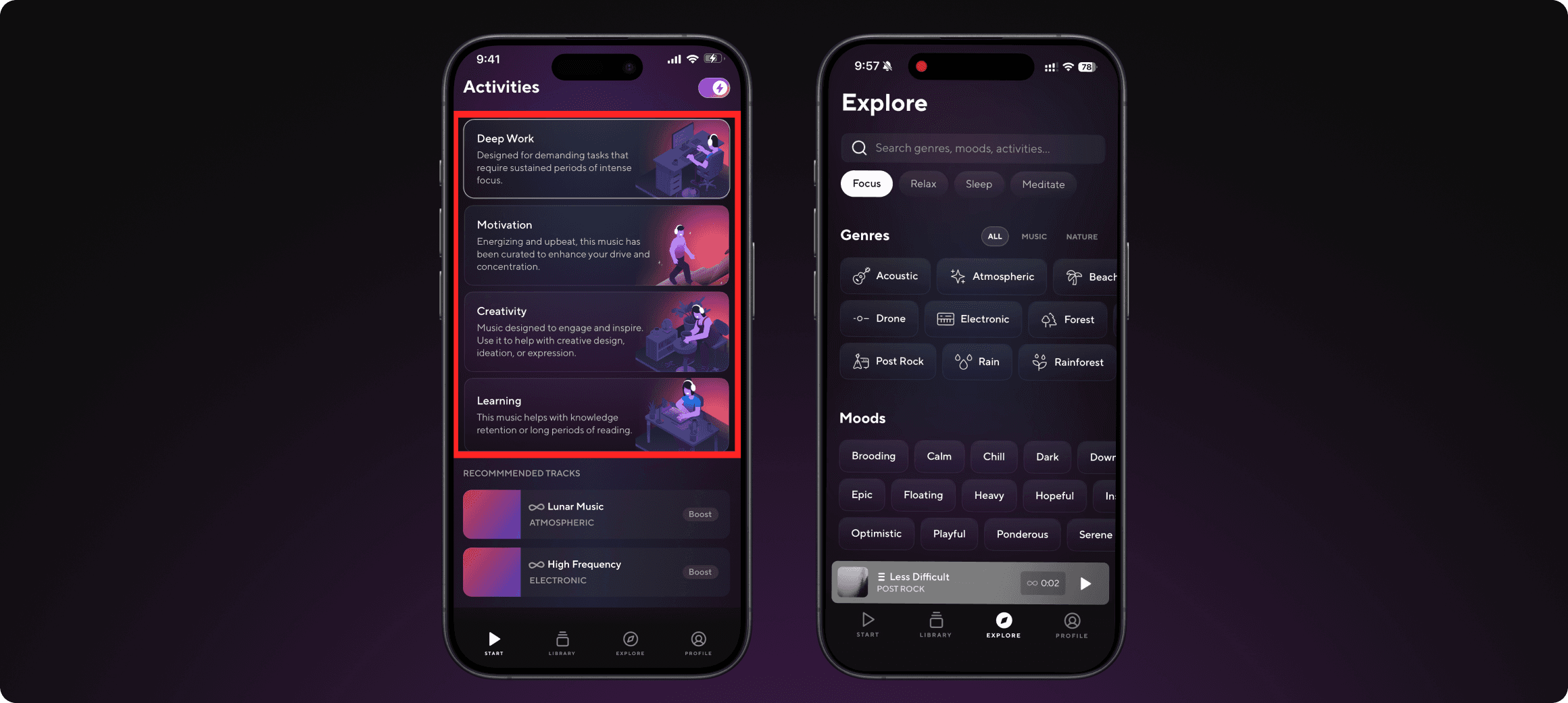

No Visual change when ADHD mode is toggled
Descriptions in the 'Explore' tab are too long and wordy, significantly reducing readability especially in a mobile environment.
Each mode has a very similar structure, and the excessive number of categories and leads to confusion and difficulty about which mode the user should choose.
Showing only what was needed
The UX writing was improved to target larger activity zones and states of mind. Majority of ADHD users only wanted to focus on


Less visual clutter
Visual difference made into the ADHD mode after toggle on to better prepare inducing focused states
Adding more than just music
Initially the app only used AI generated music after selecting a mood or task type. Though the music was scientifically created to stimulate the music there was no direct motivation technique to improve the ability of the users to get into a work state but depended solely on the music. And on testing we found that for many of our participants, the app was not getting them started to do focused work. The users themselves were responsible for that and so the app was sort of getting lost in the background and not being actively participating in getting its users to get in a state of focus.

Supplementary features
Inducing Flow state before taking them to the music
As seen previously the app was making the music but it was getting wasted in the background. So we decided to follow Dr. Mihaly Csikszentmihalyi’s work on flow and create something similar for our tool here. A new feature to the app....
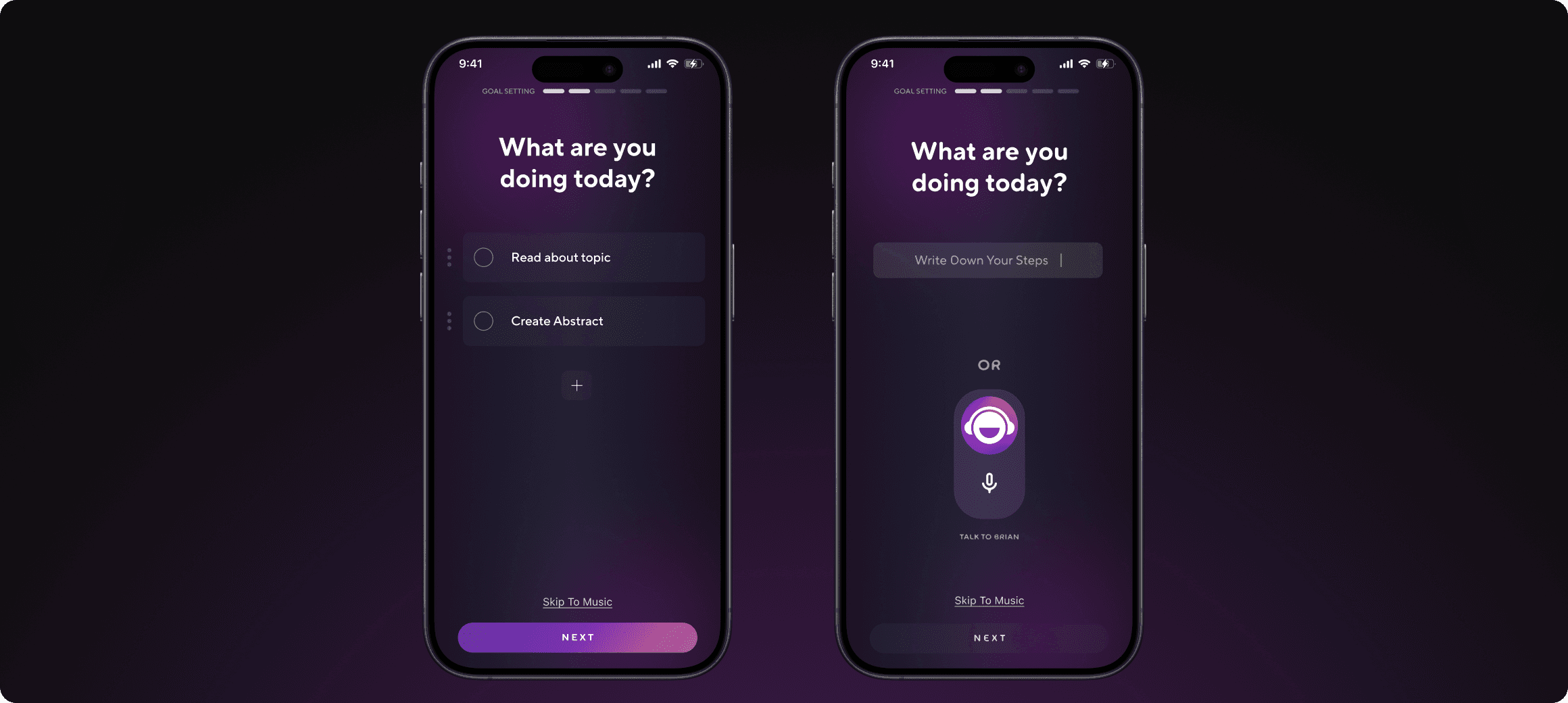
Makes focusing a conscious decision
Adds hurdles and extra steps to create sessions
Limits the type of events one can prepare for

Gives opportunity to jump straight into task at hand
The choice tiles are not fully optimized

Adds a responsive input method for starting session

Helping users visualize the goals as a part of inducing flow
The main show
Optimizing the music player
Currently the music player has a ton of extra details like neural effect, complexity and other settings which don’t mean much to the everyday users, including users with ADHD (based on our user testing set).

Similar interface as other music apps
Shows a detailed information that is hard to understand and can deviate from state of focus
Setting the pace
So instead of jumping onto music we introduced a short breathing exercise to ease into the music, to help pace users with the music being produced.

Creates a seamless transition from real world to focus inducing environment
Can be skipped if not needed
MINIMAL MUSIC PLAYER
We made the music player have synchronized visuals both when the screen is on and off with a pulsating effect for imparting rhythm to the users.

Reduces any distraction
What I learned
Key takeaways
This project was a new kind of journey for with human psychology and white paper research being a new ingredient to this dish that I knew as UX. But here are some of my key takeaways....
Test before making assumptions
On the first half of this design sprint we made a lot of assumptions about how people with ADHD would use it and created a ton of features that when testing completely failed. Reminded me why this domain is human and user centered and how we are just tools to bring it to life.
When working with physical devices, be mindful of the inherent physical functionality of the device (UX+ID)
Dr.Mihaly’s research had helped create a novelty feature for an limited use case app. Similar to this research on flow, there could be many theories unexplored, solutions misunderstood. This project reminded me that there is more to human knowledge than what we are exposed to.